
George Ramlow's Shortwave Regen Radio
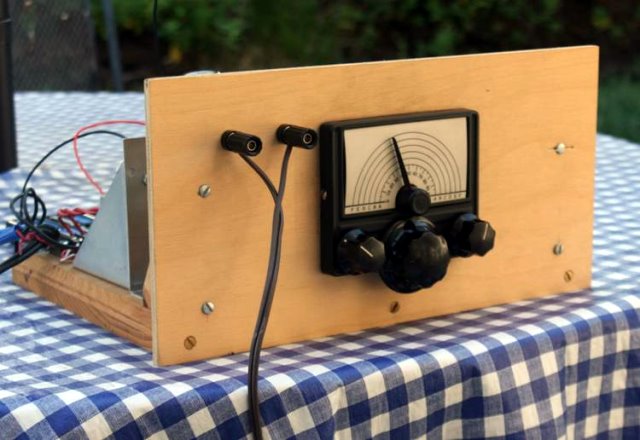


This year, I am entering a one tube regen built around one of those "useless" TV tubes, the 6HB6. This is a miniature Pentode tube that was designed to be used as a vertical deflection amplifier for T.V. receivers having wide angle picture tubes. The main features of this tube are high Transconductance (24mA/V), reasonably low Plate Resistance (28 KW), and low cost ($1 new from some online retailers); all attributes that I find desirable in a detector. It also has a nice glow, since the heater draws 760 mA. The jury is still out as to whether or not it makes a better detector than most of tubes usually used in regens, but it was cheap and it works.
The circuit is a pretty standard Armstrong (tickler coil) regen. I'm using a pair of piezo phones that I built for crystal set use. Since I'm using high value shunt resistors with them, I placed a 50 KW pot in shunt to keep the plate voltage at a reasonable level, and to attempt to match the phones to the plate. It turns out that the pot has very little effect on the output unless it is adjusted to the low resistance end of its travel.
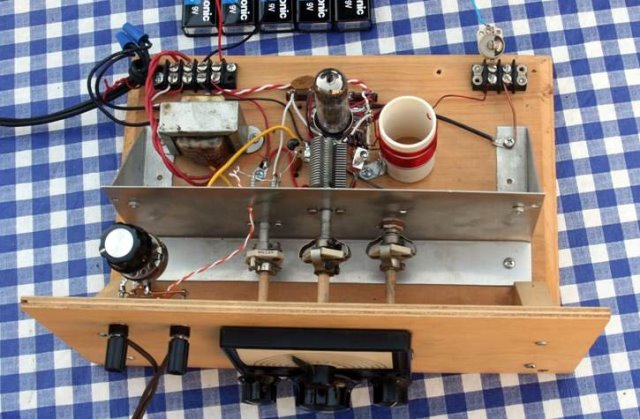
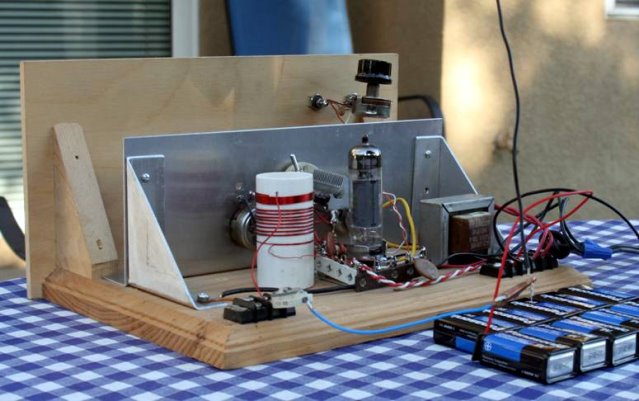
The chassis came from another project that didn't quite pan out. The insulated shaft couplers turned out to be unnecessary. I can touch the bare shafts without any change in the sound when in AM mode. In CW and SSB modes, touching the shaft produces a slight change in pitch, but not enough to detune the signal. There isn't any sensitivity to headphone cord movement whatsoever.
I bought the vernier dial cheaply. Unfortunately, it has a big hole on either side of the knob. I plugged those holes with the fine tuning and regen controls. The vernier also has backlash. Because of that, the course tuning cap is placed on the vernier, and I do the final tuning with a small variable in series with a 33 pF cap. It worked okay once I got used to it.
I used the same "temporary" antenna that I put up for last year's contest. The main difference is that a lot of vegetation has grown around part of it.
Overall, I think that performance was pretty good once I got used to the quirks of this set (as is usually the case with regens). I was more limited by the amount of time I had to listen than I was by the performance of the receiver.
Attached are my log, the schematic, and several pictures of the set. As you can see, no attempt was made to pretty up the set. B
Thanks again for sponsoring this contest. It was nice to get to do some in-depth band scanning with a radio that would probably be sitting on the shelf or scrapped for parts if it wasn't for the contest.
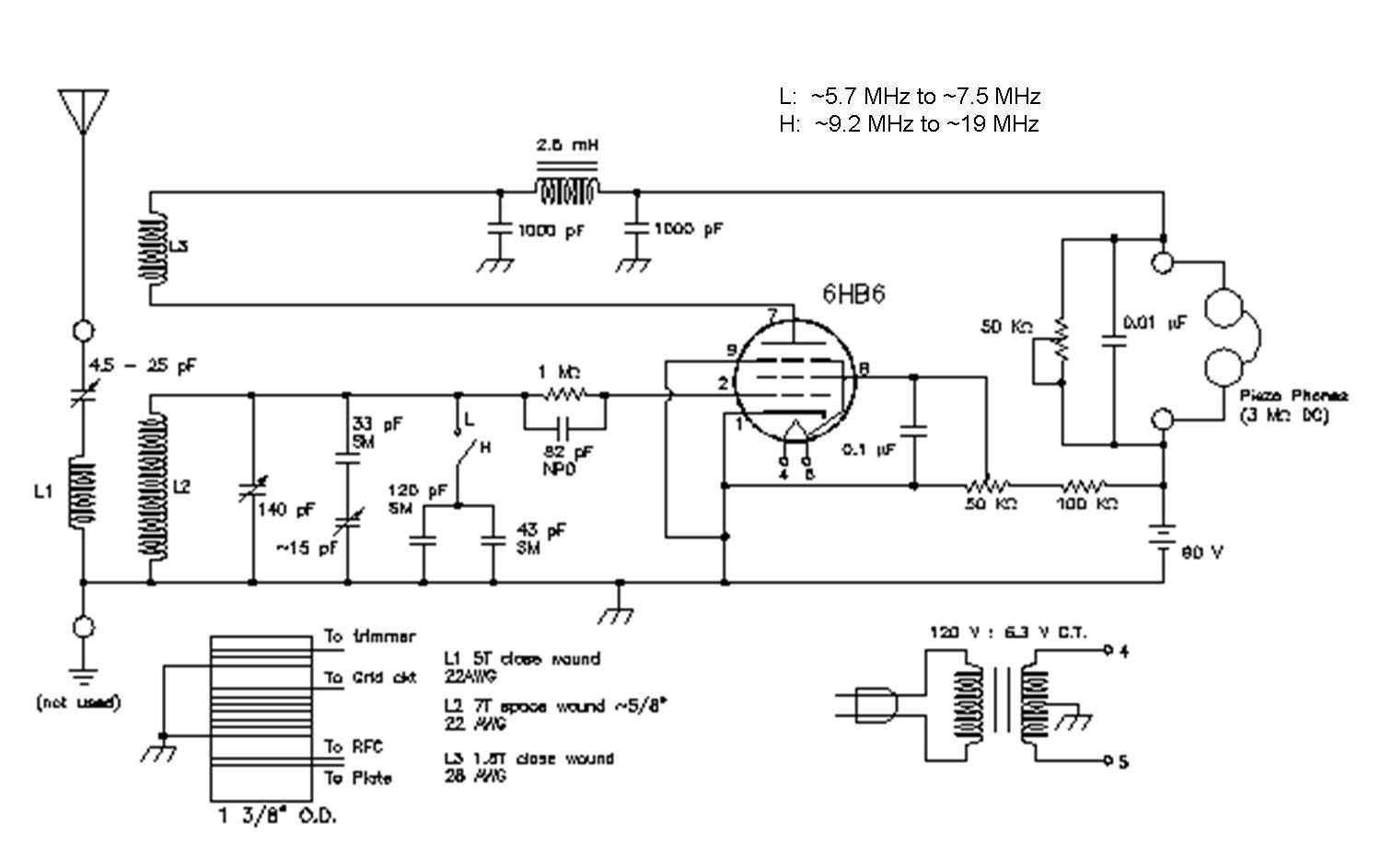
Schematic Larger View
