Uses for the Bogen T-725 Audio Transformer
Have we found a gold mine here?


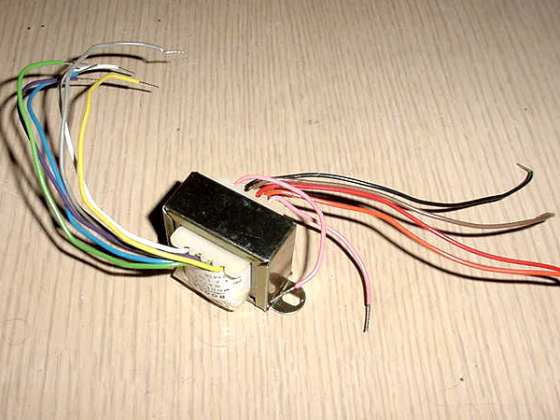
Hi folks. You crystal set fans will recognize this little part
pictured above right away. It is a Bogen T725 audio matching transformer. It's original
purpose is a matching transformer for PA system multi-speaker arrangements. Each
speaker gets its own transformer. The power that the speaker receives is determined
by the selection of the primary wires. You add up all the power levels and that is
supposed to come close to matching the amplifiers output power. I have been selling
these transformers for decades where I work.
The builders of quality crystal radios have found them useful as a matching
auto transformer between the diode output and headphones. They are reasonably priced
and readily available. What a deal!
The other night while I was sitting around, between projects and wondering
if my house really needed cleaning, I had a brainstorm (well perhaps
more of a drizzle). Why can't these
transformers be used in tube circuits? Before continuing further, I am disclosing
that I have not tried
all of the ideas I am presenting here. Please test before drilling the holes in that
nice new chassis! If you have other ideas, please let me know. I would like to add
them to this page.
These transformers are available from a variety of places.
Note: Some of the applications shown below may or may not
work so well. In inspecting the transformer, I found that the latest ones are wound
on a laminated core. This means that this transformer might stand moderate dc bias
that a class A audio stage would exhibit in the plate circuit. I never took apart
the older T725 transformers so I am not sure of the core that it uses. But it depends
on if there is an air gap on the transformer sections. This may not be. If not, then
the core will saturate fairly easy.
Comments? More ideas? Did I mess something up? Let me know by
e-mailing me.
Thanks.
The Transformer
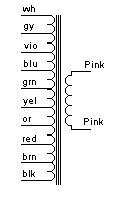
Bogen Specs. All values are relative to the black (blk) tap
     Color      Resistance     Inductance       XL @ 300 hz      Rounded Value
   White  (WH)  1424.3 ohms      24     H       45.239k  ohms      40k    ohms
   Gray   (GRY)  886.4 ohms      12.04  H       22.694k  ohms      20k    ohms
   Violet (VIO)  516.5 ohms       6.06  H       11.423k  ohms      10k    ohms
   Blue   (BLU)  260.1 ohms       3.04  H        5.730k  ohms       5k    ohms
   Green  (GRN)   81.8 ohms       1.565 H        2.950k  ohms       2.5k  ohms
   Yellow (YEL)   56   ohms         787 mH       1.483k  ohms       1.2k  ohms
   Orange (OR)    38.2 ohms         398 mH         750.2 ohms         600 ohms
   Red    (RED)   26   ohms         197 mH         371.3 ohms         300 ohms
   Brown  (BRN)   18.2 ohms          98 mH         184.7 ohms         150 ohms

   Pink to Pink    0.5 ohms        5.23 mH          9.86 ohms           8 ohms
All impedances calculated at 300Hz. This seems to be the accepted lower 3dB frequency.
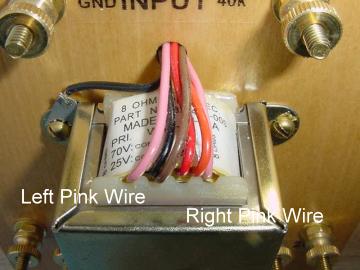
Notice the effect on the brown - yellow taps when the pink secondary is added in series
to the main winding. This could prove helpful towards achieving the exact match to your
headphones.
Ramon Vargas of Lima Peru has kindly measured and calculated the specs of the
Bogen T725. I am sure this information will be helpful to you has it has to me.
For a more in depth discussion on the Bogen T725, please download this
doc file (134k), also written by Ramon.
There is a page devoted to using the Bogen for crystal radio
audio matching,.
This page will be devoted to other uses of the Bogen.
In the old days a 1:3 transformer refereed to the ratio of the windings, not
the impedance. Now days we talk about impedance ratios. To figure this, the impedance ratio is
the turns ratio squared. The Bogen wired with the black wire as the common, the
blue wire (5000 ohms) as the input and the white wire (40000 ohms) as the output
is an 8 to 1 impedance ratio, or a 1:2.82 turns ratio. Pretty close to 1:3 and
a good plate match for many tubes too. If you connect the green wire (2500 ohms)
and the white, the turns ratio is 1:4.
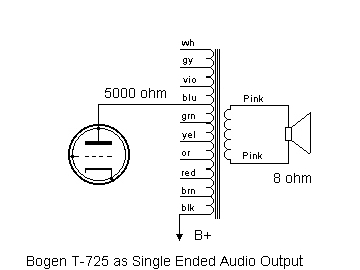
Audio Output Transformer for Single Ended Tube Amplifiers
This is a circuit that came to my mind first. This would be
good for a few watts at best. I am guessing a 6AQ5, 6AK6, 50C5, 3V4 and such tubes
could be used with the Bogen. The tap I selected is only an example. Use the tube
data to pick the tap closest to what you need.
I would keep also want to keep the plate voltage below 200 volts too. There are
no specs from the windings to ground on these.
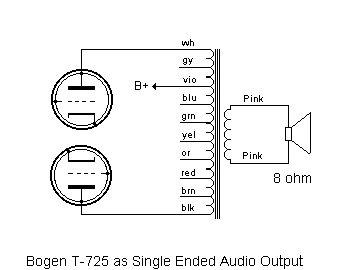
Push Pull Output
If you are building a small radio with a push-pull output
or repairing same, this might get you by. To be honest with you, I haven't tried this yet.
If you do, let me know how it sounds. You don't get much of a choice of an impedance, but
it might help until you find the right transformer.
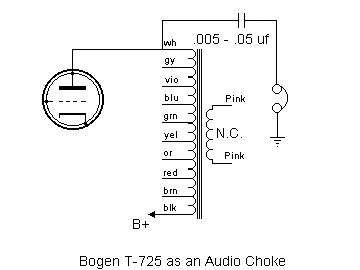
Using The Bogen As An Audio Choke
This is kind of like the circuit above. If you don't want to
run the B+ through your headphones, this is an excellent way to couple. I measured
nearly 10 henries most of the way up the transformer, before the meter ran out of
range. Another use is a B+ supply choke if you need to highly filter a very low
current (a few milliamps).
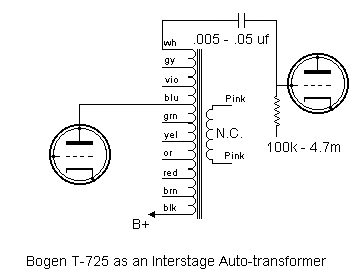
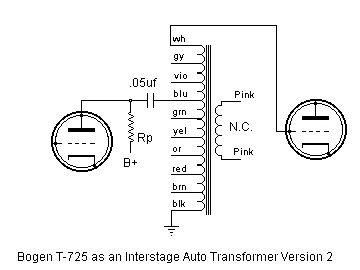
Using The Bogen As An Interstage Auto-Transformer
I saw this in a 1926 radio circuits book recently. It isn't a true interstage
transformer as there aren't two independent windings. But it should work
as a 1:? transformer. The biasing can be done at the bottom of the grid
resistor.
This variation was submitted by my friend, Fred Wise in Glen Burnie, MD.
This would solve the problem of coupling to high voltage circuits if the transformer
voltage rating seemed to be a
problem. Also you can pick your own plate load resistor. The grid bias can be applied
at the bottom of the transformer (black wire).