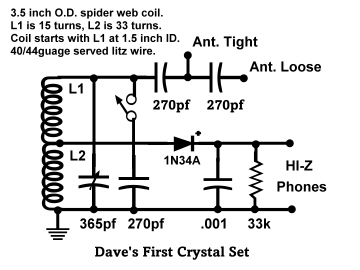
Hello crystal set fans. Thanks for
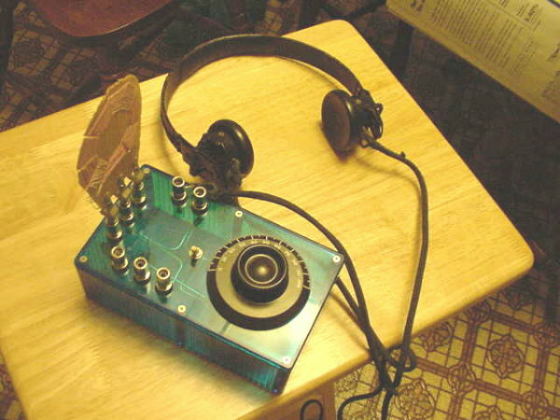
stopping by. I am proud to present my first crystal set. Here's the story:
First, a little research had to be done. I went to
Google search engine to find out
what the rest of the world was doing with crystal set design. The best
crystal radio site is Gollum's
Crystal Receiver World. This is where I found the design for my
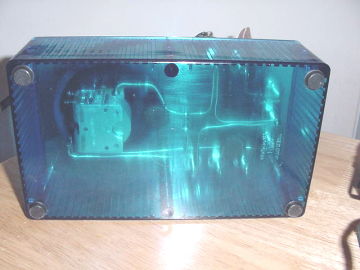
first crystal set. I did make some changes to the circuit as the box
didn't allow for easy construction with two variable capacitors. I left
the capacitor that connected to the antenna out, and instead using
two fixed capacitors that attached to two antenna binding posts.
The circuit is similar to the antenna circuit design
here.
Since a crystal set isn't a big performer as a radio, it should at least
look nifty. This is where the translucent blue box comes in.
Hammond Manufacturing
in Canada made this box. Hammond plastic boxes have always been easy
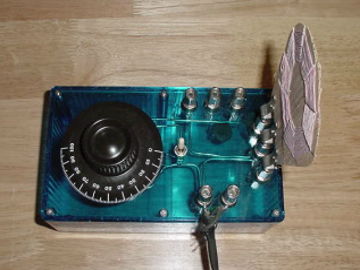
to work with. The binding posts are an all-metal type made by H.H. Smith.
The H.H Smith part number is 1835 and are around seven dollars each.
Two are needed for the headphones, three for the coil and 3 for the
antenna and ground. I had some laying around
in my surplus stuff. I don't think I would pay that much for binding
posts, but I have to say that they sure add that "sizzle" to this
set.
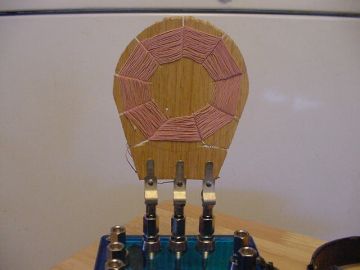
The coil for this crystal set deserves special attention. I decided
to use a spider
web coil in my design. After looking around home improvement centers
and arts and crafts store, I found some red oak wood veneer. The manufacturer
is The Cloverdale Company. The package contains 3 pieces of 8x12 inch
veneer. This is enough to make 18 crystal sets. I cut the veneer with
scissors and made the slots with a coping saw. The coil can be mounted
inside or outside the box. I chose to put the coil on the outside
using binding posts with banana plugs (Grayhill 02-1).
The coil is wound with litz wire. This is a special wire that offers
the best in radio reception. At the bottom of this page
there is a table that shows the comparison in reception between
a solid wire and litz wire coil. The drawback to using litz wire
is it is hard to come by and usually has to be purchased in pound
spool increments. Since I had more money than brains, I decided to
purchase a pound spool of litz wire. I purchased it from
MWS Wire. Each coil requires
less than 50 feet of litz wire. The wire I bought has 40 strands
of #44 wire. Each wire has a coating, and the whole wire has a
nylon covering. I am making this wire available in 50 foot lengths
at Corning Electronics Inc.
The litz wire ends need to be prepared
for soldering. Gollum's site recommended ethyl alcohol. I went
to my neighbor, Ranger Bob for
a little bit of his moonshine. I poured a little in an upside down
Pepsi can. I then lit it with a match. I followed Gollum's instructions,
by putting the end of the litz wire in the flame until red hot and
then quenching the wire in the alcohol. Be very careful not to catch
anything on fire. I did this in the kitchen sink for safety reasons.
The headphone or earphone has to be a "high impedance" (2000 ohms or so)
type. They are made as electromagnetic or a crystal earphone. If you
use a crystal earphone, make sure to put a 33k ohm resistor across
where the earphone connects. Otherwise a DC electric circuit is not
made and there will be no reception.
The tuning capacitor I used is a single gang 365 pf. I added a
switch with a 250 pf capacitor in parallel with the variable capacitor
to allow for tuning the bottom of the broadcast band.
This receiver requires an antenna and ground. The ground connection
can be made to a water pipe (NOT a gas pipe!). The antenna can be
a 50 foot length of wire stretched outdoors between two objects. Please
keep away from any power lines and use common sense when setting
up this antenna. Remember that antennas can attract lightning strikes.