|
Optimal Loading of Audio Transformers for Crystal Set Use Overall crystal set design (and construction)
criteria try to get the most of the RF power intercepted by the antenna into
the headphones, ultimately as audio-frequency power, this power being converted
into sound by the hearing element. In recent years, utmost importance has been
given to the utilization of matching audio transformers and suitable hearing
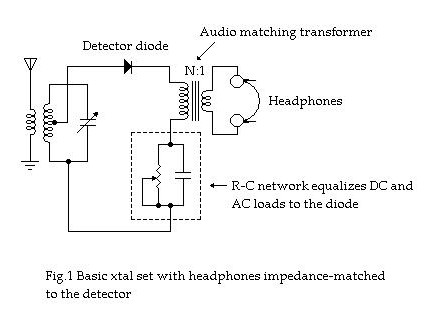
devices for ultimate volume improvements in these receivers. Fig.1 shows the
schematic diagram of a basic crystal set featuring an audio impedance-matching
stage.
This article will present technical material the author believes could be helpful to the hobbyist when selecting a suitable audio transformer for his set or when studying utilization of the one just found in the spare parts box. We shall begin making some basic power
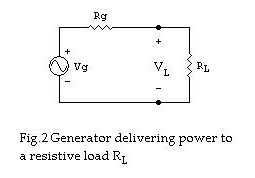
calculations. First, consider a sine-wave generator delivering power to a
resistive load RL, as shown in Fig.2. Vg is the peak
amplitude of the source voltage and Rg is the source resistance.
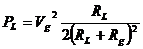
The average power dissipated by RL
is:
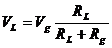
where VL is the peak value of the voltage
across the load. VL is computed as: Substitution into eq.(1)
yields:
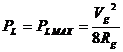
Maximum power is delivered to the load when RL
= Rg. In this particular case:
This is the maximum available power. Next, consider the situation where RL
differs from Rg and we still want the maximum available power
delivered to RL. At audio frequencies, it is common practice to
connect a matching transformer between the source and the load. This device
permits transformation of impedance levels, such that the generator “sees” an
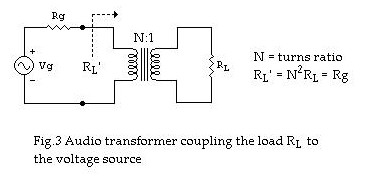
equivalent load RL’ = Rg. Maximum power is then available
and it will be transferred to RL. Please refer to Fig.3. The transformer should be a low-loss type, in
order to restrict power losses to a minimum. Usually, a specially treated
steel-laminated core is used when higher permeability values and very tight
magnetic coupling between windings is required.
In a crystal receiver, Rg represents
the detector diode’s output resistance at audio frequencies and RL,
the effective average impedance of a pair of 2k ohms DC resistance magnetic
headphones, sound powered headphones or piezoelectric ceramic or crystal
earpiece. RL must be matched to Rg
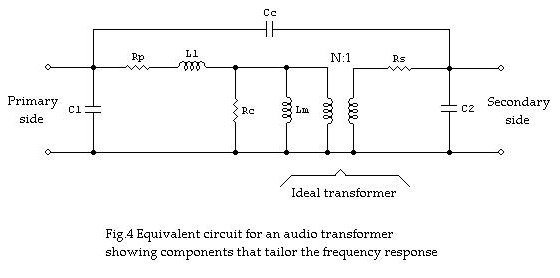
for maximum power transfer to the hearing device. Modeling a transformerAn equivalent network for an audio transformer
can be seen in Fig.4. Here, circuit parameters have been defined in terms of
the inductances LP and LS of the primary and secondary
windings, the coupling coefficient k between these windings, stray
capacitances and losses.
The following relationships apply:
Selecting a suitable transformerFor crystal
set use, a good transformer should have a flat response from 300Hz to 3000Hz
(or better) when loaded following manufacturer´s specs. Accordingly, the
following relationships should be satisfied:
…(4)
Also, at
rated loads, the effects of C1, C2 and Cc should be
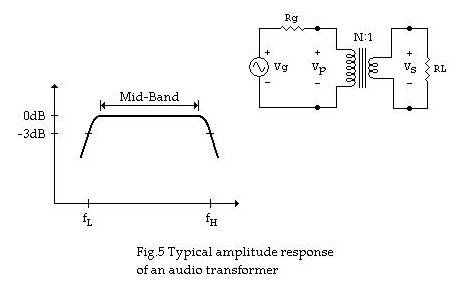
noticeable only at higher frequencies, beyond the midband. A typical amplitude versus frequency response
curve for an audio transformer is shown in Fig.5. In this figure, 0dB refers to
the output level at midband frequencies. At frequencies fL and fH
the output is down by 3dB.
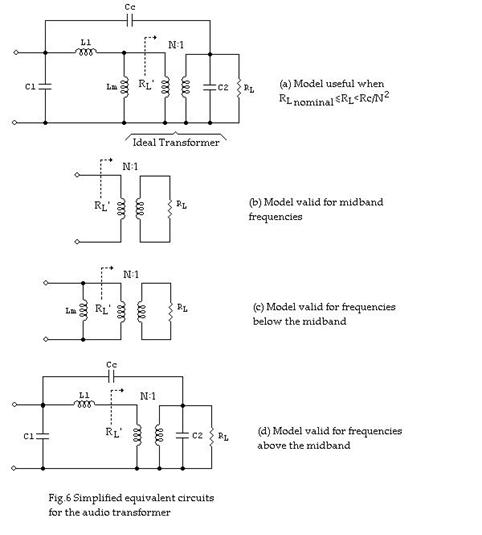
For a load resistance RL equal to or
greater than the rated value RL nominal , but much smaller than
Rc/N2, the transformer may be represented by the simplified models
of Fig.6.
We are interested in knowing if a specific transformer
will efficiently match the given impedance levels Rg and RL.
We would also like to know if the 300Hz~3000Hz bandwidth (minimum) will be
accomplished by using this audio transformer. If the device has been manufactured for audio
frequency operation (there are reports saying that small 60Hz low-voltage
power-line transformers have been successfully used as matching devices), then
chances are that it will reproduce frequencies up to at least 3000Hz. However,
attenuation at lower frequencies will be strongly dependent on the magnetizing
inductance Lm and the value of the source resistance Rg
(high-quality units may reproduce frequencies down to 50Hz +/-1dB, referenced to the midband). The equivalent circuit shown in Fig.6.c is very
valuable for evaluating transformer operation at frequencies below the midband.
We will use this model for calculation of fL, the lower -3dB
frequency (please see Fig.5). At this frequency, the power delivered to the
load RL will be one half of that available in the midband, this is, it will be 3dB down. Computing the half-power pointIf we lower the operating frequency, eventually
the primary’s magnetizing inductance Lm will start shunting the
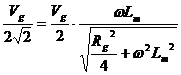
available signal, reducing the output power. Recalling that at mid frequencies Vp = Vg/2, the half-power point of the
response will be described by that frequency at which the amplitude of the
primary’s voltage falls to:
With
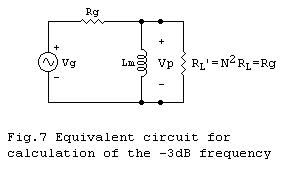
Fig.6.c in mind, we may draw the circuit of Fig.7 to help us in the calculation
of the lower -3dB frequency.
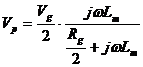
Analysis of the circuit yields for the primary’s voltage:
where w = 2pf is the radian frequency and Then, for
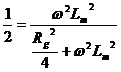
the half-power point [eq.(5)]:
or:
Simplifying:
The above
equation tells us that, under matched conditions, at the lower –3dB frequency
the reactance of the magnetizing inductance equals one half of the source
resistance. Then:
and: If the
shunt inductance Lm and the source resistance Rg are
known quantities, f3dB can be readily obtained. On the other hand,
if Lm and the turns ratio N are known, selecting f3dB
will yield the corresponding values for Rg and the optimum load RL,
recalling that Rg = N2RL. A useful
approximation for N is:
which requires
that LP and LS be known. Also, being k » 1, we may write Lm » LP. Working out some examplesCase # 1Some
months back the author received a small audio transformer having the code ST-11
stamped on its side. No technical info was available at that time. The only
known fact was that the external connection to the windings was a set of
flexible green, red, white and black wires.
With the help of an audio generator and an
oscilloscope some basic measurements were made. First, the green-red wires were
identified as corresponding to the high-impedance winding (primary) and the
white-black pair as that pertaining to the low-impedance side (secondary).
Then, an approximate value for the turns ratio N was
obtained. A 0.1V peak-amplitude 1kHz signal was applied
to the primary, giving 0.022V peak across the unloaded secondary. This yielded
a 4.54:1 voltage transformation ratio or N. However, it is recommended the turns ratio be measured under rated-load conditions
(impractical at this point of our work, as we knew nothing about the impedances
of this little transformer). The author could also get a hand on a B&K
875A LCR meter for inductance and resistance measurements. The high-impedance
winding measured LP = 19.5H and DC resistive losses of Rp = 1.236k ohms.
The low-impedance side showed LS = 0.833H and DC resistive losses of
Rs = 153 ohms. Applying eq.(8) a value of 4.84 for N
was obtained. This value is believed to be a better approximation for N. As mentioned before, the minimum acceptable
bandwidth should be 300Hz to 3000Hz, flat. In practice, amplitude response
variations of +/-1dB relative to the midband are acceptable. For the response
at 300Hz to be within this tolerance, we must select 150Hz as the –3dB
frequency (at two times the corner frequency, the response is within 1dB of the
value found at mid frequencies). From eq.(7) we already
know that at f3dB the primary’s reactance equals Rg/2. At two times
f3dB, the reactance will equal Rg. This is a useful
result, stating that at the lower end of the flat passband the primary’s
reactance will be equal to Rg. We can use the above results in the following
way. From the formula for a coil’s reactance:
the impedance of the primary winding at 300Hz (neglecting resistive losses) is found to be Xp = 36.757k ohms. The secondary winding yields a value Xs = 1.57k ohms. Accordingly, Rg should be 36.757k ohms for a –3dB frequency of 150Hz, the optimum load being RL = 1.57k ohms. A hearing device having an effective average audio impedance around 1.5k ohms will be matched to a detector diode’s output audio impedance of 30…..40k ohms. This is likely a value for a typical germanium 1N34 diode in an average performance crystal set using a tapped detector coil. If higher load impedances are used, the –3dB frequency will be shifted upwards and there will be losses at bass frequencies. For core losses to be neglected, the transformed load impedance should satisfy the following relationship:
In the present case, Rc was found to be 447k ohms (the method for taking this measurement will be discussed in a future article). As a gross approximation, a value for Rc equal to 20 times N2RL nominal may be assumed for a good audio transformer. Accordingly, the optimum values for Rg and RL should be:
Technical
data was found recently on this transformer describing it as a Philmore 20k:1k 50mw input transformer (no more info available). Case #2Our second real-world example deals with the
Calrad 45-700 audio transformer, specified by the manufacturer as a 100k:1k matching device. Measurements were taken to verify
technical data found on the Internet. Results are tabulated below.
Calculated reactances at 300Hz are Xp = 98.96k
ohms and Xs = 1.036k ohms for the primary and secondary, respectively, very
close to the rated transformed and load impedances (100k ohms and 1k ohms). The above values suggest that, under rated
loading and matched conditions, the Calrad 45-700 will yield a lower corner
frequency approximately equal to 150Hz. AcknowledgementsThe author
would like to express here his gratefulness to Steven Coles, Gil Stacy, Ben
Tongue and Dave Schmarder for their most kind technical support and
encouragement. Ramon
Vargas Patron Lima-Peru,
|




 .
.